|
|

|
 |
| Other comments left by this customer: |
|
|
|
|
|
|
|
Originally posted at: http://diehardgamefan.com/2014/10/30/tabletop-review-night-of-the-spirits-castles-crusades/
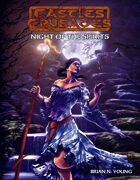
Night of the Spirits is a Halloween inspired adventure for Castles & Crusades, one of my favorite OSR style games. Of course, this Halloween is not your usual dressing up in costumes and getting treats or even a survival horror adventure heavily influenced by some Hollywood hack and slash flick. No, this adventure is based on the Celtic version of the holiday Samonios (or Samhain for the Celts amongst you). It lasted three nights and was a time when the worlds of mortals and monsters drew nigh and one could easily cross between them. This particular adventure will pit a team of PCs (Back cover says 4-8 between levels 4-6 but the inside cover says for 3-5 characters between Levels 4-6. There’s a typo somewhere!) against a Dark Druid who seeks to control the Wild Hunt into destroying his enemies. If successful, the Dark Druid will take control of the druidic order in the isles and turn it into something horrible. The players have the three nights of Samonios to uncover the conspiracy and save the village of Henlwyn.
Night of the Spirits can be ran as a direct sequel of To Kill a King which won our “Best Adventure” award in the 2014 Tabletop Gaming Awards. It can also be played as a one shot or shoved into Castles & Crusades campaigns. It’s that versatile. That said, it does have heavy Celtic roots and leanings, so you might want to be familiar with Celtic mythology or own/have read the Codex Celtarum sourcebook for Castles & Crusades. Night of the Spirits is also a VERY linear adventure, but it was purposely designed that way. After all, the adventure takes the characters through three nights of escalating horror and combat. There’s no way this piece could be made in an open world or sandbox style of adventure. Your characters can still totally investigate false leads and go in totally opposite directions as the adventure intends. That will always be true of any adventure. However since each night of the adventure is so fully planned out, the PCs and their players will have very little chance or opportunity to go off rails.
The first night of the adventure is pretty simple. It’s mostly setup, exploring a forest and there is only a single planned encounter with some bandits. The second night escalates things to include random encounters, exploring other villages, searching for missing people, a costume party of sorts, more bandits and some actual monsters. The final night is where things get big as hopefully you will have put together enough clues to figure out who is behind things and initiate the boss battle. Of course it is quite possible for the Dark Druid to succeed if the players aren’t clever enough to solve the mystery and if that occurs, your campaign will be radically altered. It’s a great piece that balances hack and slash combat with really testing the mental mettle of both the players and their characters. Most OSR adventures do revolve around dungeon crawling or straight combat, and that’s probably why I love Castles & Crusades so much – they never fail to create some highly original outside the box adventures for high fantasy.
Night of the Spirits is a pretty straightforward linear adventure that can be played in only one or two sessions. It has a fun thematic story, and it’s the perfect time of year to play or run this adventure. Best of all, it’s currently only ninety-nine cents, which means any gamer, even one that has never played Castles & Crusades should strongly consider picking this up. It’s highly compatible with any other OSR system, including Dungeons & Dragons itself. This means even if you own something like Swords & Wizardry you can convert Night of the Spirits to your preferred high fantasy game with little to no effort. Heck, you could even make this work with something like Dungeon World or Pathfinder. With Night of the Spirits costing less than a dollar, I can’t think of a reason why you wouldn’t pick this up unless you just hate tabletop RPG…and if that is the case, why are you reading this review? This is a great way to get an adventure for extremely cheap AND see why I’m such a big proponent of Castles & Crusades in the first place. It’s a well-balanced piece that exudes a fine Halloween atmosphere without being overly cheesy or hamfisting the theme into an adventure. No, Samhain is pivotal to the adventure and Night of the Spirits makes for an excellent adventure to play or run on Halloween. It’s not especially horrifying or Ravenloft-esque, but it is a fun fantasy affair that showcases what makes Castles & Crusades such a great system.
|
|
|
|
|
|
|
|
Originally posted at: http://diehardgamefan.com/2014/10/29/tabletop-review-there-was-a-dark-dark-house-firstfable/
It’s Halloween time and usually that would mean reviews for games like Call of Cthulhu, Cryptworld, Ravenloft, Chill, World of Darkness and other horror oriented games. The truth is, I already do that all year long, so instead of touching on the usual horror games we all know and love I thought I’d cover this adventure for FirstFable with its light hearted kid friendly Halloween themes.
FirstFable came out in 2012 and was designed to get young children into tabletop RPGs. The game is designed for kids ages six and up. Now I started gaming at age 8 with TSR’s Marvel Super Heroes, so FirstFable does feel a bit…less nuanced that what I learned to game with, but it’s a different time and a different generation and I can’t deny that FF is a lot easier to learn and play that going back and constantly using the cross reference tables for FASERIP on the back of the MSH books for every single roll I made. It’s a very cute, rules-lite game that parents can play with their kids and help them to learn why daddy and mommy love rolling up 5th Level Elven Mages or getting eaten by Deep Ones. Best of all, you can currently pick it up at DriveThruRPG.com for whatever price tag you want to place on it. It’s currently a “Pay What You Want” product and so if this review piques your interest, you can go back and purchase the core rulebook for however much you feel it is worth.
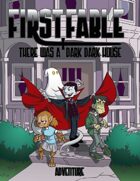
Now there, There Was a Dark, Dark House is a Halloween adventure for your FirstFable gamers. It’s not inherently scary and is actually kind of cute/sweet, but then so was A Garfield Halloween up until the ghost pirates showed up and scared the poop out of many a child who watched it. So you can make There Was a Dark, Dark House spookier and creepier if you want, but remember, it is geared for children first and foremost and most kids don’t like to be scared. Making the monsters less Chaotic Evil and more misunderstood or simply lacking in common sense gets the point across just as well and still lets the kids triumph over the situation. The adventure is written to be more lighthearted ala Mermaid Adventures, so please don’t try and take this adventure and turn it into Silent Hill if you’re running it with tykes and tots. That’s just being a jerk.
In this adventure, a little girl named Jackie has been kidnapped by a wicked witch and trapped within the town’s haunted house. The PCs are monsters who are friends with the children for whatever reason (it’s up to the player!) and set out to save the girl from her intended fate – being turned into a Jack O’Lantern! Once inside the haunted house, the characters must overcome four challenges which will then lead them to a showdown with the Witch Eliza. None of the encounters are especially troublesome (This was written for young children after all) and there certainly isn’t a threat of PC death or a TPK (Total Party Kill). If you’re looking for that sort of game, you probably shouldn’t be playing FirstFable in the first place! The encounters can occur in any order the GM wants, making it a very non-linear experience and none of them really feature combat. There is some goblin catching though. In the end, the PCs should be able to save their friend and perhaps even show the witch the error of her ways. It’s a very cute, short adventure than can be played in a single session over an hour or three. As long as you have kids that don’t need props maps or visuals to have a good time, they should have fun with this Halloween oriented FirstFable adventure. Of course, most kids are pretty good at using their imaginations, so a tabletop RPG should something almost instinctual to them.
Besides the adventure, you also get four new characters classes for FirstFable: Werewolf, Zombie, Vampire and Ghost. Of course these are all sanitized versions for children, so the vampires won’t be sucking blood, zombies won’t be eating brains and werewolves won’t be disemboweling anyone. You don’t even HAVE to play the monster character classes suggested here. The PCs could just be regular kids saving one of their own if that’s what they would before. You get blank character sheets/templates for the kids to fill out along with four pre-generated example characters. Character creation is pretty cut and dry but really young children might need help with some of the concepts or specific jargon for the game. You also get a worksheet at the end for the kids to fill out as a bit of memorabilia for the adventure they finished. That’s a really cool touch and with this, kids can remember their adventure in the Dark, Dark House.
For only $2.99, There Was a Dark, Dark House is a fine adventure for what it is. Little kids should enjoy it while seasoned veteran gamers might roll their eyes at the story and encounters – because they’re not the target audience. As a long time horror gamer myself I love the idea of an adventure in this gaming genre being written specifically for kids. They might not like scares and gore like some adults, but kids do love monsters, Halloween and costumes, so this should really make their day if they’re already starting to showing interesting in role-playing or acting. If you do have single aged children who you’d like to game with in some fashion, picking up FirstFable and There Was a Dark, Dark House might be an excellent way to get the ball rolling. To be fair though, this would have been to simple or condescending for me when I was eight, but again I was playing TSR games and reading Victorian ghost stories at that age. Most tykes will enjoy There Was a Dark, Dark House for what it is and so will the parents that run it for them.
|
|
|
|
|
|
|
|
Originally published at: http://diehardgamefan.com/2014/10/16/book-review-murder-in-corvis-iron-kingdoms/
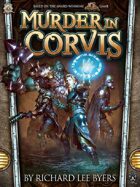
I’ll admit something upfront. I’ve never been interested in Iron Kingdoms or Warmachine. Both feel like a steampunk version of Warhammer and I already have enough RPGs and miniature combat games to pick up what feels like a derivative of something else. I’ve got a stack of Bones, Tomb Kings, Robotech RPG Tactics and my old D&D Tactics figures from when that game existed. However, I really do like Richard Lee Byers’ stories. I’m more a non-fiction reader, but I enjoy enough of his writing to know I’ll pick up something of his (especially a review copy) if I run into it. Besides, the last time I picked up a book by him from a RPG universe I wasn’t originally interested in (The Festival at Glenelg), I ended up reviewing three adventures from that game. So who knew? Maybe Murder in Corvis would make me curious enough to try out some of Privateer Press’ games. There was only one way to find out.
I wasn’t sure what to expect with Murder in Corvis. Would it read like a gritty pulp thriller? Would it be more like one of those cozy mystery series my wife enjoys? Would it simply be a fantasy novella with a murder as the crux of the story? Would it be something else? The only way was to dip into the story and find out. Unfortunately, you don’t get to find out right away. Before Byers’ novel starts you get a very dull and dry four page introduction to the Iron Kingdoms world. Personally, I would have let the author incorporate this information into the story rather than have a preamble that reads like it was written by Ben Stein, but that’s just me. Most of what is in the introduction has no bearing on the story at all and will serve to bore or confuse newcomers to the Iron Kingdoms. As well, there is a six page glossary in the back, which defines specific creatures, jargon and game terminology that the reader will encounter within the novella. I feel Byers describes all of these terms pretty well in the story itself, so a glossary of this size and the verbose descriptions provided for each one comes off with the publisher either not trusting its audience or simply being VERY condescending to them. Both the preamble and the glossary rubbed me the wrong way and definitely gave me a bad first impression of Iron Kingdoms in general. Honestly, if you had to include both of these, I’d have put a much shorter glossary in the front so that readers know it is there (most people I know don’t flip to the back of a book except for people who like endings ruined and even less read the Table of Contents in a fiction book) and I would have put the “introduction” at the end to act as a, “If you liked this story, here’s more about our world (and product line) that you can purchase,” so as not to intimidate younger/casual readers or worse, make a person think that Murder in Corvis will be as poorly written as that four page look at the world of Iron Kingdoms. I can honestly say after reading Murder in Corvis, I’d probably pick up more stories by Byers in this setting…but I’m not at all inclined to touch the game line(s).
Murder in Corvis is basically the origin story for a motley group of mercenaries that will eventually be called the Black River Irregulars. You have Milo the thief/alchemist, Gardek the Trollkin thief-taker (a trollkin feels like the defacto half-orc for this setting), Elish the arcanist (think techno-mage) forensic detective and Colbie the Mechanik, because changing c’s to k’s is somehow novel or interesting I guess. It’s the typical “one character from different classes to create a balanced party” trope that many fantasy stories have (and probably your own gaming party!), but Byers makes it work in spite of being a cliché (as always). The characters are well defined and nuanced with the cast being treated as an ensemble rather than one starring character and the rest of the team being supporting players. It’s nice to see this, because it’s rare an author treats an entire party as equals. Even in Byers’ previous novels and/or short stories with large casts, there is always a character or two that dominates the “screen time” so to speak. Aoth Fezim, Anton Marivaldi and Erik Nygaard come to mind as examples. I think all fiction authors are guilty of this because you develop a favorite (even if said favorite changes from book to book) and so they get a little more detail and word count devoted to them. Not so with Murder in Corvis. Here each chapter has a different character take center stage even when the other characters still appear in it. It’s a really nice touch that makes the piece stand out. A great example of the balance if I thought Milo was going to be the main character from Chapter One but then it ends with a twist and so I think Gardek is going to now become the main character and the first chapter was just a swerve. With each chapter unfolding though, I realized Byers’ was writing a team story rather than one focused on a single character and I loved the result.
Because Murder in Corvis is an origin story as well as a murder mystery, you get to see how the group forms. Of course, none of them really like each other at first but grow to respect and befriend each other as the story goes on and they have to work together to find the murderer. Each character gets to show off their strengths and how they can complement or protect another teammate. It probably isn’t a spoiler to say the entire team lives, but I was surprised that they lost more fights than they won and that there was a mauling or two along the way. The story flies by pretty quickly even if 126 pages is a bit long for a novella and it left me wanting more adventures with these characters. I still probably wouldn’t be interested in the Iron Kingdoms game, but I’d certainly read another story with these exact characters and author. Of course, I’m not sure if it would be interesting now that they are all chummy-chummy and the interpersonal conflict is gone, but I’d give it a try.
The actual murder mystery itself is worth noting. Apparently there is a serial killer going around. Originally just Gardek the trollkin is hired to find and subdue the killer but after he catches the wrong guy, the four protagonists are forced to team up to find the person behind the slayings. Their quest is a more cerebral one than you might expect from a story based on a fantasy RPG, but there are a few fight scenes here and there. I do like that the book really focused on solving a mystery over hack and slash, even though Byers is quite adept as long detailed fight scenes. By sticking with the detective aspects, the story felt like a murder mystery first and a licensed novelization second. I also liked that the characters didn’t solve the mystery right away, complete with the occasional dead end, false lead and accidental accusation of the wrong being thrown in for good measure. Because of the narrative style, I could give Murder in Corvis to people I know who like murder mysteries but hate gaming fiction and feel they would still enjoy this in spite of its origins.
Overall, I was glad to see that Murder in Corvis is another fine story spawned from the mind of Richard Lee Byers. Unlike some of his other releases, this novella didn’t convince me to pick up the game it was based on and I actually think the weakest points of the release are when the package tries to sell you on Iron Kingdoms instead of allowing you to just read the story, but the novella is an enjoyable murder mystery in a steampunk high fantasy setting. It’s newcomer friendly and the characters will keep you both entertained and interested from beginning to end. If you’ve got five bucks to spare and an afternoon with nothing to do, you could while away the time in worse fashions than reading Murder in Corvis.
|
|
|
|
|
|
|
|
Originally published at: http://diehardgamefan.com/2014/09/26/tabletop-review-castles-crusades-monsters-treasure/
Back in June, 685 gamers contributed to the Castles & Crusades Kickstarter, allowing Troll Lord Games to put out a Sixth printing of the Player’s Handbook, along with new printings of Monsters & Treasure and the Castle Keeper’s Guide. For the first time, all three core C&C rulebooks would be released in full colour with glossy pages. For a long time Castles & Crusades gamer who has been there since the beginning, this was a pretty sweet deal and I happily jumped on board.
Now I should point out that this version of Monsters & Treasure is more than a mere reprint with color pages. The previous printing was under 130 pages, while the newest printing is 178. Some of this is because the new printing has a larger, easier to read font size. Some of this is the new artwork made especially for this book, and some of it is slightly altered/edited content. This is NOT a new edition of Monsters & Treasure a la the Fifth Edition Dungeons & Dragons Monster Manual that also comes out this month, but simply a reprinting. This means that if you own a previous printing of Monsters & Treasure, you don’t really need this one. You already pretty much own this book. Now if you WANT to buy a new printing for the new layout, color artwork, glossy pages and/or to support Troll Lord Games for making such an awesome product, then by all means – do so. However, your old version will work just as well. Again – this is NOT a new edition. You can always check out my review of the Player’s Handbook from this printing to see how the first printing, fifth printing and sixth printing all are pretty similar themselves. All that said, if you have to get a copy of Monsters & Treasure, you might as well start with this latest full color printing once it is available to the general public.
Now at 178 pages, Monsters & Treasure is pretty slim compared to some other bestiaries. The 5e Monster Manual is twice the page count at 352 pages, and it’s JUST monsters. Numenera‘s Ninth World Bestiary is about the same size and that game has only been out for a year, so you would think after all these years and printings, that Troll Lord Games would beef up poor old Monsters & Treasure by now. Alas, it is not to be. Of course, Monsters & Treasure is a fraction of the cost of the 5e Monster Manual so the reduced price of the C&C bestiary matches the reduced page count. That said, if you find that Monsters & Treasure doesn’t have all the cannon fodder and antagonists you need it to, you might want to invest in Tome of the Unclean or Classic Monsters. Both are fairly cheap and contain a good deal of monsters to supplement the core Monsters & Treasure book. Monsters & Treasure does have all the big name creatures like dragons, vampires, werewolves, elementals, golems, orcs and more, so you probably should start with this one.
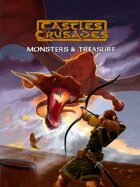
Aesthetically, Monsters & Treasure has never looked better. Sure a lot of the art is reused and is simply in color now, but after years of black and white only books from Troll Lord Games, I can’t express how fantastic this thing is in colour. The inking and colouring jobs make the piece look like they always were in color. It’s gorgeous. I really enjoy a lot of the new art too, especially the cover where that Ranger is about to shoot an arrow down the gullet of a red dragon. Simply beautiful. Of course, as great as the art is, Monsters & Treasure is not a coffee table book to gaze at, but a collection of stat blocks for you to fit into your Castles & Crusades oriented adventures. Of course, mechanics is where Castles & Crusades is terrific and because 99% of the stat blocks are the same as in previous printings (typos and errata have been fixed), you should be able to make use of any of these monsters in any of your OSR/retro-clone games without any trouble. Each monster entry is primary stats and mechanics with only a paragraph of descriptive text for each creature/race. If there is more text, it is generally about specific powers said creature has or an explanation on how the Castle Keeper can use them in combat. So if you are looking for a lot of fluff and prose about the creatures in question, Monsters & Treasure is probably not the book for you. If you are a veteran gamer and don’t need to be told what an orc is or how a vampire comes to be, then you can just absorb the stats, mechanics and strategies each entry contains.
Of course, the book is Monsters and Treasure, so I should probably talk about the loot side of the book as well. Usually magic items and treasure are found in a games Dungeon Master’s Guide equivalent. Not so with Castles & Crusades. I’m not sure why Troll Lord games does it this way, but I have no complaints. Part of the reason PCs kill monster is for their treasure after all, so it makes sense to have them both in a single, easy to reference, tome. The treasure section is only about fifty-five pages of the book, so while it’s not the majority of the content, it is nice to see a significant amount of content on the topic.
In the treasure section of Monsters & Treasure, you are primarily given information on magic items, including how to make them. That’s always helpful. There’s even a handy-dandy chart for the gold cost of items other than scrolls and potions. For those on the other side of things, there’s also a section on how to DESTROY magic items. Several pages are also devoted to sentient items and special abilities they might possess. Something you might not expect to find in the Treasure section is the “Lands and Titles” piece. Here you’ll learn about how each character class gathers followers and what they do with land. It’s an interesting piece for when your characters get mid to high level.
Other than that, the magic item section is pretty standard for the genre. You have lots of tables that are broken down into types of items followed by a list of what the items of that type are. After all the charts are detailed descriptions about each item be it a magical sword or boots of the north. For those that are curious, yes you will see classic D&D items like the Deck of Many Things, Rings of Protection and the Robe of the Archimagi. Remember, Castles & Crusades is an OSR game and uses the OGL.
All in all, Monsters & Treasure is pretty much the same as it has always been, but in a new fantastic all-color package. If you’re brand new to Castles & Crusades, I can’t recommend this game highly enough. If you are a veteran of C&C like myself and already have a Monsters & Treasure book in your possession, you don’t NEED to get this version as it is almost exactly the same as previous printings. Still, if you like the larger font, full color art and the like, you can always pick this up as a spare or even give your older printing to a friend to help get them into the hobby. Again, if you’re looking for a high quality retro-clone fantasy game, Castles & Crusades is one of the best. There’s no better time to jump on the bandwagon then now!
|
|
|
|
|
|
|
|
originally published at: http://diehardgamefan.com/2014/10/10/tabletop-review-13th-age-bestiary/
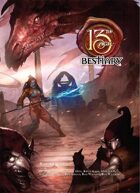
It’s been a great year for tabletop antagonist collections. Troll Lord Games put out their new edition of Monsters & Treasure. Wizards of the Coast put out the extremely well received Monster Manual and so on. Lost in the shuffle however was Pelgrane Press’ 13th Age Bestiary, which sort of surprised me as the core manual was really well received by critics and gamers alike. Since its release, however, it’s been hard to find someone who is playing or talking about the game save for some hardcore pockets of fans on the internet. Take this very Bestiary I’m reviewing today. If you go to DriveThruRPG.com, there aren’t any reviews and even Amazon.com doesn’t have any for you. I noticed something similar at Free RPG Day when the 13th Age adventures were continually passed over for other offerings at the gaming stores I visited. Perhaps in both cases 13th Age products were just getting overshadowed by the other releases that came out around the same time. God knows it has taken me two months to review this due to my own gaming backlog and even now it was mainly because I felt sorry for the book. It’s too good of a release to be ignored.
If you’re unfamiliar with 13th Age, the best way to describe it is as, Fourth Edition Dungeons & Dragons done right.” Now I know there are some D&D 4e fans out there, even some that prefer it to the other editions of the game, but the majority of gamers really seem to loathe it. There are soon interesting ideas and good concepts, but it ended up being a system I enjoyed the sourcebooks for but really didn’t enjoy playing. 13th Age however takes a lot of the good parts of 4e like healing surges and an emphasis on background and combines it with some of the best parts of 3e D&D. It’s definitely worth picking up the core rulebook, but it is a pretty cost-prohibitive line where the PDFs are a lot more pricey than comparable products from other gaming systems and the physical books are only a tad bit more. If Pelgrane could reduce the electronic prices to something more in line with the rest of the industry, they might be able to rekindle some interest (or generate some new) from casual or less experienced gamers who think the industry is just D&D and Pathfinder.
So let’s talk the 13th Age Bestiary. Although the page count is similar to a lot of other (cheaper) monster collection, there are only about fifty monsters in the book. Now that may disappoint some of you when you read this as you were hoping for at least a hundred or more creatures to kill or throw at your players, but that’s all you get it. Accept it or don’t get it. What you get as a trade off if an exceptionally detailed look at each creature, along with three to eight variants of each monster, giving you a lot more options than you would normally see in a collection like this. The extreme amounts of background information fits the general idea of 13th Age wonderfully. After all, if players get bonuses for detailed background information, why not apply the same level of detail to the cannon fodder, mid-boss and recurring foes? The end result is something that reminds of the best Monstrous Compendiums from the AD&D 2e era, with great art and equal attention paid between stats and informative text about the ecology, personality and background of these creatures. It’s going to be personal opinion on whether quality or quantity is more important, but as a game that strongly prefers role-playing to roll-playing, I think the 13th Age Bestiary is a wonderful example of what makes the product line so popular with its core fanbase and also what would make it a fine fantasy alternative to those who are bored with the Big Two.
When you first look at the contents of the Bestiary, you might be a bit puzzled as to what made it in and what didn’t. For example you’ll see Black, Red and White dragons, but not Blue or Green. Why? Hey, it’s their book. Maybe they couldn’t think of enough Green and Blue variants. It’s also interesting to see what B-Lister (or lower) creatures were included and elevated in this collection. Redcaps, Mycanoid, Intellect Devourers, Sahuagin and the Chuul are given more love, respect and detail than I’ve ever seen. The Chuul has always held a special place in my heart so it was fantastic to see this recreation of the creature in terms of motivation, personality and worldview. It’s discussing these “lesser” creatures with the same care and attention to detail that the Drow, Tarrasque and Ghouls get. The game even pays attention to the dog vs dragon Kobold argument that has been going on since Wizards took over the D&D line from TSR. I love the little things like this.
There are also some new creatures that the game can call its own (unless I’ve somehow missed these are d20/OGL releases somewhere else). You have something like the Warbanner, which is a living magical flag. It almost feels like an homage to Warhammer. You have the Whispering Prophet which appears to be a demon who tempts the desperate. There are Wibbles which seem like a version of Ioun Stones that someone came up with after a few too many hits of LSD. So on and so forth. There are some really neat new original creatures here which shows that 13th Age is NOT just another game expecting the OGL to do all the work for them.
So what’s bad about the 13th Age Bestiary, Well, we have already covered that it’s a bit overpriced for what you get and there are far less creatures in this collection than in ones for other comparable games. It’s also perhaps worth noting that the narrative style might put off a good portion of gamers, especially those who prefer older OSR style games. While I think the writing is witty, intelligent and fun, even I can’t deny there is a level of pomposity and arrogance to it which will leave a bad taste in the mouth of some gamers. The writers definitely comes off saying, “Our game is best. We know fun. You don’t. If you have a different opinion, you are WRONG.” I don’t think this is intentional, but I also know I’m not the only person who has flipped through this and come away saying, “Wow, did an editor not warn them how bad the tone of this piece can be?” Take for example the Rust Monster article. It starts off by badmouthing the DM vs Players attitude of some of the oldest versions of RPGs. Which I agree with, but that’s not really something to do in a Monster Manual type book. That’s for blogs and editorials. Then it says things like, “The shoutback is an angry curse against an irritating monster that threatens fun.” No, no monster does that. That’s bad writing and BAD thinking. A monster, an adventure and even a game is only as good as the DM running it. You would think authors who gave such depth to the Bullette would know that. It’s a bad DM that threatens fun. A good DM can make any monster work and certainly not as “just” a punishment tool. It gets worse with phrasing like, “We’re not sure if the rust monster is particularly fun but we can see that it has a place in some campaigns, or perhaps only in some sessions.” That is a terrible attitude to take. “SOME Campaigns” reads like “THOSE KINDS OF PEOPLE.” Which is a massive faux pas. Things like “Rust monsters are such a hateful element of the fantastic ecology” that you have to wonder why they included the creature in the Bestiary at all, save to run down gamers who like to play a different style of game. I don’t honestly believe that the authors of the 13th Age Bestiary are that elitist or arrogant, but OSR fans are already going to be on the defensive after that paragraph denouncing the Gygaxian way of gaming and that is just coming to come across as “We took your money but we don’t want you to play our game. Screw you.” That’s how bad word of mouth spreads. Although I like 13th Age, things like this make me not want to play the game even though I agree somewhat with the intended meaning of the poorly phrased soapbox rant. The whole thing comes across as tacky and classless. A better editor or publisher could have prevented this from going out with such an unfortunate tone. Alas.
Overall, the 13th Age Bestiary is a fun but flawed piece. It’s a bit lacking in creatures, is certainly overpriced and the authors have the occasional attitude problem, but each entry is exceptionally in-depth, well written and it’s a fantastic addition to a one of the best new lines from 2013. It’s certainly a must have if you’re already a fan of the line, but at the same time, you will need the core rulebook or the entire Bestiary will come off like gobblygook with mechanics and writing that assumes you already know everything about the setting and world. My advice is to hold off on the 13th Age Bestiary until you’ve purchased the core rulebook and/or played a few games in the system. If you like what you see, then yes, you’re going to want to run right out and purchase this. It’s very well done. It’s not perfect, but it’s very well done.
|
|
|
|
|
|
|
|
Originally published at: http://diehardgamefan.com/2014/07/23/tabletop-review-ripples-from-carcosa-call-of-cthulhu/
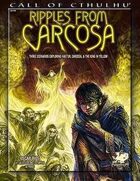
Ripples From Carcosa originally started life as a Monograph, which is a Call of Cthulhu piece usually done by a single person. The art is minimal, the editing and layout are done by the author and they are generally barebones pieces that cost a lot less compared to full-fledged releases, but quality on these things varies. Something about Ripples From Carcosa convinced Chaosium to re-release it with new art, edited and added content and a snazzy new full color cover. Now this isn’t the first time a monograph has been given an upgrade so to speak. Cthulhu Invictus, for example, started off as a simple Monograph and now it is a full-fledged setting! I actually own the original Ripples From Carcosa monograph and while I enjoyed it for what it was, I wasn’t really sure what they were going to do to it. Well, the fact the new version has twenty pages more content, new art, some editing and retolling, in addition to the new PDF being HALF the cost of the original Monograph – well, why wouldn’t I throw money at this thing???
Well actually, before we get to the positive side of the review (which admittedly sounds like a commercial for this piece), there are three minor reasons why you might not want to pick this up. Let’s get those out of the way in case they are dealbreakers for you. The first is that this new version of Ripples From Carcosa is done with Seventh Edition rules and Mechanics. Now, 7e isn’t out yet, which may make you want to wait to purchase this as. As well 7e has some very mixed reactions from the CoC fanbase, which happens with any game whenever a new edition comes out. So if you are interested in Ripples From Carcosa but don’t want to put the time into using the conversion guide in the back of this release, or you have no interest in moving on to Seventh Edition, considering getting the Monograph version. The second reason is that Ripples From Carcosa takes in three different settings: Cthulhu Invictus, Cthulhu Dark Ages and End Time. Because of these three different setting, you might feel like you need to buy all three books to play Ripples From Carcosa. You don’t, but as some publishers do like to do that passive aggressive hard sell of their other products in that fashion (Paizo, I’m looking at you), you might read this as a hard sell of these other books, which drives up the cost of Ripples From Carcosa a LOT. Thankfully, the book tries to alleviate this feeling by giving advice, tips and setting information about all three time periods. This helps, but not as much as if you were say, a Keeper that owned the three books Ripples From Carcosa references and are experienced with all three. You can still run Ripples From Carcosa just fine and you don’t need the three other sourcebooks to make it work, but I can’t deny you will get more out of the adventure with a keeper who has done his or her homework and is somewhat familiar with both Invictus and Dark Ages to make the imagery of the pieces come more alive.
Finally, anal retentive Mythos pursists might have a problem with the way Hastur and the King in Yellow are portrayed in this collection. Here you’ll find the Great Old One as extremely malevolent, cruel and downright evil. We’re talking supervillain or tying a damsel to a railroad track evil. Obviously this is quite different from how the original authors Ambrose Bierce and Robert Chambers presented these characters. It’s even very different from Lovecraft’s take on Hastur, which was different from the original authors of these characters, which is my point. This is one author’s interpretation of the characters and while it is very different from the creators, that doesn’t make it inherently bad. The adventures are still extremely fun and well designed. I mean, I’m a pretty diehard Chambers fan and I have enjoyed both versions of Ripples From Carcosa in spite of this interpretation of these characters because it’s a GAME. It’s not as if this version will somehow erase the original (correct) versions of these characters from the collective unconsciousness. Sure, this version of Hastur is similar to what Derleth did with the character but in the exact opposite direction (Derleth made Hastur kind of the “Good” Great Old One), but you know what, as diehard a Hastur/KiY fan as I am, I enjoyed Derleth’s very different interpretation of the GOO and I enjoyed Ripples From Carcosa even if the Hastur here is as far from the more benign god both Bierce and Derleth saw him as. If the thought of Hastur as sort of a mustache twirling Nyah-ha-ha’ing “I can’t pay the Rent/You must pay the rent!” evil-doer makes you angry enough to want to go to some message board and start venting with copious amounts of profanity, then man, just don’t buy this. Also, learn to take games less seriously.
So let’s talk Ripples From Carcosa. This collection features three adventures, each from a very different time period, roughly 1,100 years apart each time. The collection is designed to be a short campaign, although there is no real reason why you can’t play these adventures as stand alones if only one or two calls out to you. Each stage of Ripples From Carcosa features pre-generated characters. You don’t have to use them, but segments of each adventure were written with these characters in mind, so if you run different characters than the ones included, the Keeper has a bit of work to do to ensure things run smoothly. As well, all three adventures are interconnected with each time period using reincarnations of the previous characters. At certain points in the adventure, the characters can receive Cthulhu Mythos and Hastur Lore points earned from their previous incarnations. This is really neat and helps to make the campaign stand out as something really unique. Each adventure is very different from the last, so it’s not like you’ll be replaying the same thing three different times with only the backdrop changing. The end result is a very memorable campaign where even if your characters die horribly or go totally insane in one adventure, you’ll get another shot at stopping Hastur’s machinations down the road. Unlike a normal campaign where you are probably pulped by tentacles, locked away in an asylum or take your own life.
The first adventure, “Adventis Regis” takes us to the time of the Roman Empire. The Investigators are having a lovely time at a resort town, where they and their families are relaxing, playing and seeing the sites. One of the highlights of the trip will be a performance of a new play by Livius Carbo, who has been a bit of an eccentric shut-in as of late. If you’re a fan of Call of Cthulhu at all, you can probably connect the dots here. Anyway, as the date of the play’s first public performance draws closer, things start to get a bit creepy and people seem to be a bit out of sorts. No matter, you’re on vacation, right? Well, when the PCs get back from a scenic cruise, everything has gone to hell. An entire town has gone insane. Whoops. Can the Investigators survive long enough to discover what has happened and if there is a way to stem the tide of madness?
This is a really fun adventure that in some ways reminds me of a survival horror video game. It’s less terror oriented and more action-packed that most CoC pieces, and players will really have to be on their toes here. Stealth skills are VERY helpful here, but only one or two of the pregens has it at a decent enough level. Oddly enough the slave character has a higher Stealth than the professional Thief. Anyway, “Adventis Regis” isn’t necessarily a hard battle, but it is different enough from a lot of Call of Cthulhu adventures that the usual tropes of Library use and the like won’t be of much help here. The piece is creepy like a modern horror movie rather than filled with a sense of alien dread, and that’s okay as “Adventis Regis” is a fine way to start off this collection and helps set the stage for the two adventures to come, along with the eons-long grudge the Investigators will have with Hastur.
The second adventure, “Herald of the Yellow King” is our Dark Ages piece and it is somewhat similar to a few other King in Yellow adventures out there in that the players have to stop a local town (their own in this case) from melding with Carcosa. This is a pretty long adventure as character will be travelling all over the countryside to several small villages trying to piece together the strange occurrences in the fiefdom. It’s a very creepy piece and is by far the most traditional Call of Cthulhu adventure in the collection. The different villages and what befalls them are a great part of the fun and really helped to make this my favorite adventure of the three. There’s a lot of weird happenings, a mystery to solve and at the core of things, a truly tragic tale where all of this horror could have been prevented had people not been well…the kind of thoughtless jerks people usually are.
Although combat is a big part of the adventure, and there is a good chance the Investigators will thrown down with the King in Yellow itself, words and writing will actually win the day here (as opposed to the previous adventure) which really helps to showcase how different each piece in this collection is, even while they as so inter-connected. I also loved how the adventure has six different endings. Now that’s well thought out! This adventure also has the best artwork in the collection. There are some amazing KiY images here.
If you are only going to play a single adventure out of Ripples From Carcosa, this will probably be the one you pick. It’s also the easiest adventure to adapt to another system. I found this converts very easily to Dungeon Crawl Classics and Lamentations of the Flame Princess for example. It’s the right time period and it’s sufficiently weird enough that fans of those games would never know they were actually playing something steeped in BRP mechanics.
Finally we come to “Heir to Carcosa,” which will be the piece people will either really like or really hate. It’s set in the middle of the 22nd century in a reality where Earth has been taken over by Great Old Ones. The time was right, R’lyeh rose and things went quickly to hell. The Investigators are now part of a colony amongst the asteroids along with some Elder Things, a few Yithians and some occasional M-Go that act as trading partners. It’s an interesting concept but one that is more Derleth than Chambers, Bierce or Lovecraft so some people might dislike it on that grounds.
Anyway, the Investigators in this time period are happily living on the colonies when their Mi-Go trading partners let them know about a ship from Earth in the general vicinity. The colony orders you to intercept the vessel and prevent it from returning home, lest they reveal their whereabouts of the colony and risk it being conquered in the same manner as Earth. From there you get all sorts of craziness. You find out the earth ship is as insane as its crew members (almost HAL style), you get an unexpected and interesting tie-in with the first adventure in the collection. You get a slight flashback to our own current era (kind of) and you even get to encounter the daughter of Hastur and perhaps even kill her! This does not make pappy too happy by the way. “Heir to Carcosa is a bit of on-rails adventure compared to the previous two as it is very straight-forward without a lot of room for deviation. It’s perhaps the least satisfying as it just kind of peters out in the climax without any real resolution (run until Hastur gets bored or eats you), although you do get a schmaltzy end to the story and campaign as a while. The idea of all these races working together in space to avoid GOO detection was a fun concept and the adventure itself where you’re exploring a creepy lunatic spaceship, playing psychoanalyst to a computer via virtual reality and trying to take out the daughter of Hastur is all very outside the usual things you encounter with Call of Cthulhu adventures. Although it’s not something I’d want to play regularly, as a one-time end to a campaign or for a change of pace, this was a lot of fun.
So Ripples From Carcosa still remains as enjoyable as it ever was. I remember when it first came out I described it to people as, Hellraiser: Bloodlines with Mythos creatures instead of Cenobites and without Alan Smithee.” With an eleven dollar price tag for the PDF, this is a real steal. Sure it is VERY different from the usual CoC campaigns and adventures, but that’s kind of the point. There’s only so many times you can play the same old Deep One or Shaggai related adventures without things getting humdrum. Ripples From Carcosa takes a chance by doing something very different: allowing players to experience three different time periods in one mini-campagin and being different enough from the usual Call of Cthulhu pieces that it stands out as a truly memorable experience. Aside from the four potential dealbreakers I mentioned at the beginning of the review, this is a great way to not only test out Call of Cthulhu, Seventh Edition but also three other available settings besides the usual Gaslight/1920s/Now options we all tend to cling to.
|
|
|
|
|
|
|
|
Originally posted at: http://diehardgamefan.com/2014/10/08/tabletop-review-for-rent-lease-or-conquest-pathfinder/
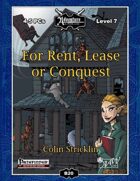
With third party releases for Pathfinder, the bad tends to outweigh the good. Because so many companies just throw out things for Pathfinder without any sense of balance or quality control, the really good third party releases can get lost in the shuffle. This is doubly true for release with a sense of humour. They’re rare enough as it is, but to find a comedic adventure for Pathfinder that is also exceptionally well done, well, the old “needle in a haystack” cliché is more than apropos. That what makes me so glad I found and picked up “For Rent, Lease or Conquest.” The adventure is a lot of fun, it is as funny to play as it is to read through and it really shows that there is still originality and cleverness left in the Pathfinder market instead of a bunch of adventures that are little more than derivative dungeon crawls. For Rent, Lease or Conquest isn’t just one of the best Pathfinder adventures I’ve experienced this year, but it is one of the best adventures, regardless of system.
For Rent, Lease or Conquest is for four to five Level 7 characters. It is also compatible with Dungeons & Dragons 3.5 and a few other OGL systems and as such it contains stats for both primary variants. The adventure is a direct sequel to a previous release from AAW Games entitled, Death & Taxes. I have neither read nor played that one so I can’t comment on its quality but I can say that For Rent, Lease, or Conquest is perfectly standalone and you do not need the previous adventure to make it work. The adventure contains multiple maps and all the antagonist/monster stats you will need to run the adventure, making it a rare Pathfinder product where you are not prompted to look through or purchase three or more other books besides the core rulebook(s). I love this. It’s a nod to how expensive and overwhelming Pathfinder can be and also keeping costs low for the potential purchaser of this adventure. Because this piece doesn’t require more than the core rulebook and the adventure itself, it’s a wonderful way for newcomers to experience Pathfinder. They get to play a mid-level character and see that not every adventure is “enter a dungeon, kill things for loot and repeat until dead or the mission is over.” This is exactly the type of piece I would use to introduce someone to Pathfinder, especially if their previous RPG experience was with a more thinking/less hack and slashy system.
For Rent, Lease or Conquest is a lot of things rolled up into one fantastic adventure. First it covers the issue of a guildhall or place for the adventurers to rest their feet. I remember when I was a kid, the biggest challenge in AD&D 2e was not playing the game, but what to do when you character leveled up enough to have followers and/or a keep to maintain. Sure it’s cool your Ranger attracted a Basilisk ally, but where will you guys stay when you’re not murdering dungeon inhabitants. You can’t live in hotels forever! In the case of this adventure players are given a simple hook. There is a large and impressive looking house in town that may be haunted. The local real estate agent wants it off her books for tax purposes. She can’t sell the thing, so she offers the PCs a deal – clear it out and it is theirs for free! Everyone wins. Of course the adventure won’t be that simple…
The second aspect of the adventure is that much of the piece mirrors the typical “haunted house” style dungeon crawl. These tend to work better in games like Ravenloft, Chill or Call of Cthulhu but that’s because those houses tend to actually be haunted with something. In the case of For Rent, Lease or Conquest, the house isn’t actually haunted. It’s filled with some unusual squatters and it was built by an eccentric sorcerer so it’s understandable by the local peasants assume something spooky dwells within the manor. Half the fun of the adventure is the house and its different denizens. What I really liked it that the focus isn’t on the usual hack and slash rigmarole that turns too many OGL adventures into generic trash. Sure combat is potentially plentiful, but the adventure is more about exploring and encounters. Most of the encounters can be solved by talking or using one’s wits instead of a blade. This is absolutely fantastic and a wonderful alternative that more adventures should offer. After all, the Bard’s gift of gab and the Paladin who put on their skill points into Diplomacy and other talking based skills are just going to waste otherwise! The inhabitants of the house are amusing, charming and memorable and are a wonderful example that not all sentient races look or think alike. The end result should be one that has players wistfully remembering this piece for months or years to come.
The third part of the adventure that I absolute love is the climax. After the PCs have solved the problem, some thugs have come to claim the house for themselves. After all, it’s worth a lot of money and property always goes up in value, especially when it is built by a famous architect. After all, you never know what inflation is going to do to those electrum pieces you’ve been storing under your bed AND there isn’t much of a concept of interest banking in fantasy RPGs. Now the roles reverse as the players can use the magic nature of the house (and its inhabitants) that once stymied them against the GM. Indeed, the roles of the PCs and GM switch at this point with the PCs configuring the layout of the house and its abilities to stop the invaders while the GM acts as the adventuring party, guiding the ne’er do wells through the house until they meet a gruesome or comedic end. This is such a wonderful breath of fresh air with this piece and it will surely be a highlight for everyone who plays it.
I think it’s pretty obvious that I can’t say enough good things about For Rent, Lease or Conquest. It’s original, innovative, imaginative and most of all – a lot of fun. This adventure shows you can have a good dose of comedy in a piece and yet still have it be something the players and their characters can take seriously. It’s smart, self-aware and is a perfect response to all the usual reasons people say they don’t enjoy Pathfinder. I can’t recommend this highly enough and it really is the best Pathfinder adventure of the year. Every third party company (and even Paizo to a degree) should consider this required reading on how to write an adventure that captivates rather than relying on standard tropes and generic dungeon crawls. Definitely a must have for any fan of the system.
|
|
|
|
|
|
|
|
Originally published at: http://diehardgamefan.com/2014/09/23/tabletop-review-alternate-dungeons-haunted-house-pathfinderd20/
Unless characters are very low level, it’s pretty hard to pull off a proper haunted house in Pathfinder or Dungeons & Dragons, Third Edition. After all, Paladins, Clerics and Necromancers all have special abilities versus the undead, and typical denizens of a haunted house (Ghosts, Spectres, and Poltergeists) are a bit too much for someone at Level 1 or 2. Even Ravenloft, the gothic horror campaign setting for AD&D 2e, didn’t really do so much with haunted houses, as it would be a dungeon crawl in a sprawling manor or castle. This is why haunted houses tend to be better left to games like Call of Cthulhu, Chill, Shadows of Esteren or Hunter: The Reckoning. Of course, this doesn’t mean a good haunted house is impossible with a d20 system – just that it’s very hard to make a high quality one that espouses feelings of horror and terror. This is where Raging Swan Press’ new supplement comes in handy. Alternate Dungeons: Haunted House is a short, twelve page PDF that breaks down into five distinct categories to better help an enterprising DM come up with a haunted house that is scary, yet fits into a system where a starting level character can make zombies run in fear of their holy power.
Alternate Dungeons: Haunted House is a short piece, but you do get two versions of the PDF when you purchase it. The first is optimized for printing, while the other is optimized for screens, such as your desktop, laptop or e-reader. Visually, there isn’t really a difference between the two, but the print one is a larger file, due to higher resolution images. Both are bundled together, but the only time you should open the print version is when you’re planning to well, print a copy of this off.
The first section is “An Alternate Dungeon,” and it gives details on what a haunted house is in high fantasy terms along with how to run one like a dungeon. I do strongly feel that if you run a haunted house in a manner similar to a dungeon crawl, you’re very much missing the point of one, but Alternate Dungeons: Haunted House does things far more to my liking that most attempts at horror in a d20 system. This is because the piece tries to obscure the fact that one of its haunted houses is still a dungeon crawl, while still helping a d20 oriented GM run a spooky manor or long abandoned castle with the terminology and jargon they are used to. This means the overall experience is definitely less of one that you would get from a system or game that is geared for horror/terror, but it’s also leaps and bounds above anything of the sort I’ve seen released for Pathfinder so far. It’s not a knock on Pathfinder as a system – just that horror is harder to pull off than say, Call of Cthulhu, because it’s not expressly designed for it, whereas CoC IS.
Also in “An Alternate Dungeon” are examples of how to spruce up the location with special powers to circumvent typical PC actions. Cursed mirrors, penalties to divination and Detect Magic spells. Even animated objects and weakened floorboards make it in here. There is a really nice list of atmospheric options coupled with mechanics to help a Pathfinder GM make a spooky house. Unfortunately, some obvious options, like penalties to turning undead or other ways of nerfing clerical/necromantic magic are missing here, which is a significant oversight. This section ends with a list of lootable goods that one would normally find in a haunted house. It’s a decent list, but again, incomplete. No mention of any ancient grimoires, spellbooks or cursed objects for example. So this could have been fleshed out more, and longtime horror gamers will spot these flaws outright, but what’s here is still really good, especially for those new or inexperienced at running a haunted house based adventure.
“Dressing” gives you a list of ways haunted houses come to be, such as curses, murder, suicide or other tragic events that may have occurred within the home’s walls. This section also includes a d100 chart of haunts. It’s a well-made and versatile list that should serve newcomers well, although veterans of horror gaming will probably want to pick and choose to create a more cohesive piece.
“Denizens” is a list of eight possible creatures that would be inhabiting a haunted house. The CRs range from 2 to 9, with an interesting mix of options. Some are fairly obvious, like the ghosts and wraiths. Some are less obvious, like vampires, witchfire and shadow demons. Again, this should really be helpful to a newcomer who is plotting their first haunted house adventure out.
“Traps and Hazards” are just what you might expect, but with a haunted house motif. Bleeding walls, collapsing floors and pit traps are just some examples of what await you in this section. I’m kind of surprised things like falling chandeliers, shattering mirrors and secret wall based traps didn’t make it into this section. There are three new haunted house oriented haunts that appear here: anguish, dancing décor and slamming doors. I would be honestly surprised if these hadn’t been done already in some other d20 supplement for horror gaming, but I can’t think of one, so it’s great to see these haunting tropes given d20 mechanics.
Finally, we have “Adventure Hooks,” which give you three short synopsis that a GM can flesh out and turn into full fledged adventures. Obviously, these will take a bit more work than purchasing an already written adventure, but for those of you who are suffering from writer’s block or are taking the first steps into homebrewing adventures, what’s here are some basic elementary ideas that should get your creative juices flowing. I personally like The Seaside Massacre best, but if you find one that leaps out at you, you should definitely use it!
Overall, Alternate Dungeons: Haunted House is one of the best horror minded supplements I’ve seen for Pathfinder in many years. It really tries to hide the flaws that come about when you try to do horror with the d20 system while also accentuating the system’s strengths. Veterans of classic horror systems won’t find much here to use except some specific d20 mechanics, while newer, less experienced or more casual horror gamers are the perfect target audience for this piece. Alternate Dungeons: Haunted House can really help make a spooky old mansion become more than just a generic dungeon crawl with a new coat of paint slapped on it. Just in time for the Halloween season, no less!
|
|
|
|
|
|
Creator Reply: |
|
Thanks very much for the comprehensive review, Alexader. I much appreciate it and I\'m delighted you enjoyed Alternate Dungeons: Haunted House! |
|
|
|
|
|
|
Earlier this month, the core author and creator of this particular RPG sent me an email and asked me if I reviewed his game. I said sure and now that I’m mostly caught up with the GenCon glut of stuff that comes out every year (I just have to review The Strange and Warhammer: The End Times – Nagash) I’ve had a chance to read through and play a bit of Of Gods & Heroes and I have to say, it’s pretty good.
Like a lot of games, Of Gods & Heroes takes place during the mythological age of B.C.E. Most people will instantly go to Ancient Greece and/or Rome in their heads when they hear this, and yes, much of the games artwork and mechanics examples is from this period. However, of Gods and Heroes is more the GURPS of Myth-genre RPGs as it can be anywhere. DO you want to do a Native American setting? You can. Do you want Norse or Egyptian? The game is flexible enough for this. Do you want to play in Shinto priests in feudal Japan? You can! Of Gods and Heroes is more about the concept of a mythological setting than tying itself down to one specific pantheon. Of course that means games like Weird Wars Rome, Cthulhu Invictus and Mythic Iceland will probably be a better choice if you’re looking for a lot of depth on a specific place and time. For those who want a flexible game that can let you play a campaign in Mayan times and then the next with Innuit folklore, Of Gods & Heroes is a great choice that will only be limited by your imagination and ability to put the source material together yourself. Hey, it’s only 162 pages. You should not go into this game expecting a primer on ancient world religions. That’s just silly.
Speaking of silly, the narrative in Of Gods & Heroes is a bit light hearted compared to a lot of RPGs that can be quite dry to read. Now, this doesn’t mean Of Gods & Heroes is written like HoL, but it does mean that the book reads more like a friend explaining a game to you rather than how a core rulebook usually comes across. So you’ll see the Amazon PC example referred to with her left boob cut off instead of “breast,” NPCs and cannon fodder characters are referred to as “splats” and Thor is called “spanktacular.” This is neither bad nor good, but one of the many ways that Of Gods & Heroes stands out. If you prefer your games a little more somber or stoic, you might not enjoy the narrative style of this book. If however, you’re used to the off the cuff writing style of games like World of Darkness titles, you’ll be pretty at home with the way Of Gods & Heroes is written.
Mechanically, Of Gods & Heroes is a mix of old school Shadowrun and World of Darkness games. All you will use are six sided dice, which makes the game a bit more affordable and easier for newer/casual gamers to try. They should be two different colors though – one color for regular dice and one for prowess dice. Prowess dice come into play with your character concept. Your Prowess is your core descriptor. Hercules would be Strong and thus get Prowess dice for physical actions like wrestling or hucking things. Eagle-eye Jake would have a Prowess of Keen-Eyed, and thus would get Prowess dice for spotting hidden objects, perception, looking for traps and the like. You have a lot of options here, along with an Epithet to flesh out the concept. So Hercules’s Prowess would be Strong and his Epithet would be Mighty (Or Incredible if you are Greg Pak). So why are these dice a different color than the regular ones? Well, for a good reason. When you make a roll (Test), a success is a 5 or a 6. If a Prowess die comes up a 6, you get to roll it again. Now, if they were all the same color, you could point at the six that you rolled and say, “That was my Prowess die!” If you don’t get any successes, you fail at the action and if you get all 1s, you Botch and something bad happens. Botches are exceedingly rare as they all have to be 1s, so feel free to make them spectacular.
Although the dice rolling described above is pretty much the core of the game, there are a lot of mechanics examples with these. So the game is easy to learn, but a bit hard to master. This means GMs will be flipping back and forth through the book for some time until they feel comfortable will all the possible rules for combat, sailing, swimming, poison, starvation, social tests and more. It does feel like a lot when you read through the book for the first time, even though only thirty pages are devoted to the various mechanics in the game. Perhaps it just feels that way because the back of the book has a dozen pages of charts. The game reads a lot more mechanics heavy than it really is. Once you re-read it or play it a bit you’ll see the game is fairly intuitive and flows smoothly.
Character creation is pretty easy. Things are extremely freeform as you pick your personality, Fatal Flaw, Prowess and Epithet. Then you get 25 points to put into skills. Each level of a skill costs a single point, except Rhyme which costs two. Rhyme is one of two types of magic, along with Ritual. Both let you cast different types of spells, but Rhyme is a lot more powerful and off the cuff so it costs double.. Starting characters can only have a maximum rating of 4 in a skill, but as they advancement in-game, they can get higher than that. Finally you pick your Fate (which is essentially your character’s destiny) and you’re done. Character creation shouldn’t take very long at all unless you’re trying to Min/Max which, while possible in Of Gods & Heroes, is a bit silly.
Besides of all of Of Gods & Heroes has a nice section for GMs – which are called Chroniclers in this system. If gives some fine advice on how to gun a game, how to deal with players that go off the rails and how to design adventures. There’s also a mini Monster Menagerie featuring thirty-three different creatures to throw at your PCs. I do think this setting could have used a page or two showing GMs how to make their own creatures, especially at is does feel geared towards younger and/or newer gamers, but even a rookie GM will be able to figure out how to do that after they spend some time reading and running Of Gods & Heroes.
In all, Of Gods & Heroes is a very well made game. It tries to account for every possible situation or rule you might need, while still trying to be a more “rules-lite” style game. Character creation is easy and quick. It even includes a list of 101 story seeds to create your own adventures/epics. It does lack a full starter adventure like a lot of RPGs, which would be of help to newer gamers or those that don’t like to use homebrew adventures, but that’s okay. The $15 price tag is a bit high for a PDF in this day and age, especially when you can get more detailed game with better production values for around the same price. Still, what’s here is pretty good if you are looking for an all-encompassing or generic mythological setting RPG. As mentioned earlier, those that want a more specific and detailed look at a pantheon have several other options to choose from, but Of Gods & Heroes is more about flexibility and an easy to learn system than anything else. I’m usually not a fan of mythological setting RPGs and to be honest, Of Gods & Heroes really wasn’t on my radar before I was asked to review it. That said, mechanically and design-wise Of Gods and Heroes is a well-designed and interesting game. Sure it might not be something I’d play myself, but I can’t deny that gamers who do want to play a game where you are Grecian Demigods or African Tribal Warriors being used as pawns of the gods that you might want to pick up Of Gods & Heroes and see if it fits your needs. I definitely enjoyed it for what it is and I really hope it finds an audience, because it deserves to.
|
|
|
|
|
|
|
|
Originally posted at: http://diehardgamefan.com/2013/11/05/tabletop-review-horror-stories-from-the-red-room-call-of-cthulhu/
Chaosium Monographs are pieces that are largely edited and laid out by the author(s) in question rather than by the actual employees of the publisher. Because it is generally very hard for a writer to edit or even see their own mistakes, Monographs can be very hit or miss in terms of quality. More often than not, they are filled with typographical, grammatical and editorial errors that would have easily been caught by a different pair of eyes. Now, this is not an across the board condemnation, but rather a generalization. After all, there are some great monographs that have been of a higher quality than some full fledged Call of Cthulhu releases. Just look at Mysteries of Ireland and Children of the Storm. I’d put those up as some of the best monographs, and easily some of the better Chaosium releases, in some time. Unfortunately, Horror Stories From the Red Room is one of those products that gives monographs a bad name, as the adventures are sub-par and the editing is just terrible. I think this is the first Chaosium release in two years that I have to say up front, “Wow, this is a stinker. DO NOT BUY!” to.
You know something has gone horribly wrong the second you go to the table of contents page. Now, the monograph is only 108 pages long, yet the table of contents seems to think this piece is over 150 pages long. “Dear Ladies,” the first adventure in the collection, is the only one listed as starting on the correct page, which is 5. From there on, it goes insane. “Horror Stories From the Red Room” supposedly starts on page 39. It actually starts on page 16. “Northanger Abbey and the Necronomicon” is listed as starting on pages 150-152, and then the next adventure, “Splatter Punks,” is listed as starting on page 154. The final adventure, “Three Maidens of Bingen,” is listed as starting on page 144. Oh my god, how did this get through publishing? There were seven authors on this thing, which implies seven editors, and not a single one noticed how messed up the Table of Contents was? It’s the first thing players and purchasers will see! Unfortunately, I bring up the Table of Contents in great deal because it is a perfect example of how badly done this book is in all respects, with the adventures generally being poorly written and edited with this same lack of regard for quality. I’d actually be ashamed to be one of the authors in this collection, which is sad, because there are some good CoC writers in the mix that simply just half-assed their way through this collection.
The first adventure is “Dear Ladies,” and it’s the best of the bunch. It’s the only one to stick to the original theme of the piece, which is Chaosium’s yearly Halloween offering, and it’s mostly free of errors. I should also add it’s the only adventure any of us found to be any fun to actually play through. “Dear Ladies” is a black comedy about two elderly ladies whose neighborhood feud has gone from petty comments and cruel pranks to a mutual decision to inflict homicide upon the other. One lady decided to just break in and beat the other one down. The second lady decides to use the power of the occult to summon a “demon” from another dimension to commit murder at her behest. A little bit extreme, but hey. This is where the Investigators come in. They’re here for a Halloween party thrown by one of the two women, so they have an alibi when everything goes nutty. Can the players keep both women from fulfilling their murderous desires while keeping a classic Mythos creature at bay? This is definitely a well laid out and potentially amusing adventure, and it’s the crown jewel of the lot. 1 for 1.
The second story is the titular adventure for this piece, “Horror Stories from the Red Room.” Unfortunately, it’s not very well done at all. For example, the piece takes place in a two floor estate, and it provides you with a map of both levels. This is fine in theory, but not in follow through. You see, each room on the map is numbered on the map, but it does not list which room is which. Conversely, the text of the adventure gives a description of each room, but does not correlate to which number on the map they correspond to. Another example of sloppy editing. The adventure is also missing details like the approximate year the adventure takes place (although you can surmise it by reading the text and inferring the author’s intent), and there are some odd decisions, like having the Investigators being paid $20 flat to investigate the history of some paintings and their creator. I have a feeling the author has no idea how long authentication and historical research into little known figures actually takes, as twenty dollars for a group of people to do this would be chicken feed, even in the 1920s. The piece is littered with huge and obvious inaccuracies that a good Keeper can catch and fix before playing, but that should have been the author’s or an editor’s job in the first place. Finally, the adventure relies far too heavily on the idea that the players and/or Keeper have Secrets of San Francisco, and the adventure cannot be played to its potential without it. One of the big cardinal rules of adventure writing is never to make a piece so reliant on a single not core rule book that it can’t be played without it, but that’s the case here. With all the errors in this piece, I’m shocked Chaosium chose it for publication. It’s just bad in all ways across the board, both to read and to sit through. 1 for 2.
Next up is “The Inheritance,” and while it is a fairly standard, paint by numbers haunted house adventure, it’s well written (especially by the standards of this piece). It uses a lot of tropes such as time loops (It felt like I was reading about The 7th Guest at times…), an inability to leave once Investigators have entered the building in question and a ghostly mystery that only the players can solve. Again, all stuff we’ve seen before numerous times, but the adventure is laid out well, organized nicely and it flows properly. It might make a good adventure to start a campaign or to introduce people to Call of Cthulhu, but more experienced players may find it dull and too familiar. 2 for 3.
Our fourth adventure is “His Pleasant Dream Was Shattered” and it’s not very good. The premise is that an eccentric alcoholic millionaire has caused a bit of trouble and may be sent to Arkham Asylum due to what appears to be a tenuous grasp on reality. Investigators are hired to… well, do a lot of crap actually. They have to keep him out of the asylum, keep him from going to jail, break his ties with local mob affiliates and help him confront the root of his once subtle madness. This adventure is just far too busy and all over the place, with tasks that the Investigators have to accomplish. Worse, if the players fail at a single task, the adventure ends in spectacular failure, and that’s just nonsensical. So are some of the solutions to these tasks, one of which involves taking the client, somehow finding family remains that were eaten by ghouls FOUR YEARS AGO, and then killing one of the ghouls whose only offense was being seen by this schmuck and whose pack actually went out of its way not to kill him when they met previously. This is just so stupidly written, and the goals the author has set out to accomplish wouldn’t actually cure the client of his depression, madness, alcoholism and more. For the ghoul goal, why not just show him they are real? Hell, any experienced Cthulhu character would go, “Oh, there are absolutely ghouls in this crypt? Let’s bring some assorted meat based leavings and bargain with them to go somewhere else.” If only, because human on ghoul violence generally turns out very bad for the humans in this game. Randomly murdering something, even a Mythos Creature, that is just doing what comes naturally to it would be a sanity loss in any other adventure, but not here. No, this really needed an editor to straighten out a lot of plot incongruities and issues that are quite obvious just in reading the piece, much less trying to make it playable. This really needed two or three passes by an editing table before being considered fit to print. 2 for 4.
“Northanger Abbey and the Necronomicon” is adventure number five, and it’s in the same vein as the terrible mashups like Pride and Prejudice and Zombies, Sense and Sensibility and Sea Monsters or Wuthering Heights and a Werewolf that were all the rage several years ago and quickly burned out. Not only is this adventure riding on the coattails of an idea that has long since become passé, the author picked yet another Jane Austen novel to mashup with something horrific. If you’re going to ape an idea already done by someone else, why not pick an author from the same time period who has been overlooked? Even the Restoration period! That hasn’t been touched except for Samuel Pepys, who’s diary has already been used in numerous horror and mythos mashups. Edmund Burke, John Locke, Samuel Johnson, John Bunyan, William Blake, Hugh Walpole. Get creative people!
The adventure itself is loosely based on the novel Northanger Abbey, but mashed up with Cthulhu Mythos references like Hastur worship, byakhee summoning, vengeful ghosts from beyond the grave and mind swapping rituals. It’s interesting, but unless you know the book, the adventure loses what little charm it has, and if you or any of your players do know the book, you risk someone nitpicking the adventure to death or complaining about where and how the adventure deviates from the book. It’s kind of a lose-lose situation here, and the adventure is best read rather than played… but then that’s not a good thing to say about an adventure. I will say that the adventure can be a lot of fun if played with a very specific makeup of players and a Keeper that knows his or her Austen in addition to CoC mechanics, but that’s just too niche of a target audience to make this recommended. 2 for 5.
The sixth adventure is “Splatterpunks” or “Splatter Punks.” The name of the adventure changes throughout the monograph, again giving a nod to the terrible editing job in this piece. It’s an outside the box adventure, taxing place in the 1980s, and is a nod to weird horror movies like Ghoulies, Critters, Troll and other films from that era that had somewhat comical monsters wreaking havoc on a town. The adventure feels like it would work better with Chill or Cryptworld mechanics, but that doesn’t make it a bad fit for Call of Cthulhu – merely something that is very different from the norm, and as such, players may dislike it for its lack of anything relating to the usual CoC moods, themes and monsters. Now, while it’s not personally an adventure that would be my first choice (or even my second) to run for Call of Cthulhu, it is very well written, and I appreciate that it eschews all the usual done to death bits of the system and setting. I also had far more fun with this adventure than I thought I would, and this ended up being my second favorite in the collection. I also think this adventure has the best art in the monograph – such as it is.
The adventure involves a bunch of teenagers accidentally summoning a pack of murderous goblins to their town through the arcane ritual of playing a song backwards on a heavy metal album. What do you know – it actually worked! Of course, there is a little more to it than that, but it’s a cute take on classic 80′s urban legend (The only one I was ever able to make a hidden message appear on was by “Weird Al” where it said, “Satan eats Cheese Whiz.”) The investigators are either kids from the town or their usual characters that have the bad luck of passing through once the ritual has been completed. Players then have to try and find a way to send the goblins back to their own dimension, before they burn, pillage and murder everything in the little town. I will say the adventure had some unexpected comic relief, as one of the goblin summoning kids just happened to be named Matt Hardy. The adventure was then filled with constant jokes about his name, ranging from “Fat Hardy” whenever he ate, to people saying “Matt Hardy… WILL NOT DIE!” whenever he escaped a potentially dangerous situation. Note to authors: never name your characters after pro wrestlers, especially in a horror game, as the suspension of disbelief goes out the window entirely and cannot be rebottled. Still, “Splatterpunks” is a more comical adventure than most, so it actually fit the mood the adventure was trying to create. The biggest criticism I have about the piece is it refers to a previously published monograph but doesn’t give its name. Instead it just lists it as “CHA0404.” Most people don’t know a tabletop publication by its internal call letters. Some more bad editing. 3 for 6.
Our last adventure is “Three Maidens of Bingen.” Now, I have a confession to make. I have reviewed well over a thousand products in the past eleven years, and god knows that since I have been writing for and about the gaming industry, I have encountered some truly god awful adventures or video games. Things so bad that, without hyperbole, I have mentioned that I would rather face bodily harm than spend time with that product again AND MEANT IT. While “Three Maidens of Bingen” is far from being that level of awful, it is the first adventure that has ever been so dull, dry and boring that I FELL ASLEEP reading it. I’m a guy that reads extremely dry non-fiction for fun, so you would think I’d be immune to what was the equivalent of “Ben Stein in Ferris Buller’s Day Off” dull, but no. This was such a stinker I literally fell asleep trying to wade through this piece. It also didn’t help that, at twenty pages, this was the LONGEST adventure in the collection as well. Ugh. I’m sure the author isn’t normally this bad. I think he just got overzealous with putting every minute detail he could think of into the adventure, and it just magnified his already dry and dull writing style. Just be warned, if you do buy this, have some caffeine handy. Why am I allergic to caffeine, dammit?
“Three Maidens of Bingen” is for use with Cthulhu Invictus, a campaign setting taking place during the golden age of Rome. Thankfully, the adventure gives you enough information that you don’t actually need the campaign setting books to play through this. Unfortunately, you have to deal with the writing style to get the pertinent information. The crux of the adventure is that river shipping is being blocked, causing commerce to die down and tensions to grow. There are several possible red herrings as to what could be at the root of the problem, from River Pirates to supernatural entities. The players have to find out what is going on and stop it before anarchy reigns. Sadly, the idea is as dull and formulaic as the writing style, but there are some interesting ideas. I think that in the hands of a better writer, this could have been a lot better. Perhaps the author would work better as an idea man rather than a scripter? All in all, this was the worst adventure in the collection, and considering there are some real turkeys in here, that says something. 3 for 7.
So out of seven adventures, only three are any good, and of those three, there is only one that I think would be fun for a large cross section of Call of Cthulhu fans. Horror Stories from the Red Room is a perfect example of how a monograph can go spectacularly wrong. Bad ideas, bad adventures and certainly bad editing litter this piece from beginning to end, and I can safely say this monograph is not only the worst offering from Chaosium in several years, but is something to be avoided unless you foolishly agreed to review it. You know, like me. Save your money and your sanity points, dear readers, and pick up something else instead.
|
|
|
|
|
|
|
|
Originally posted at: http://diehardgamefan.com/2012/08/02/tabletop-review-mysteries-of-ireland-call-of-cthulhu/
Mysteries of Ireland is the latest low-frills Call of Cthulhu publication known as a Monograph. Monographs are CoC supplements, adventures or texts that Chaosium publishes, but has not done any of the art, editing or layout for. Because of this the books can range from extremely high quality like Children of the Storm to subpar offerings like Ghosts in the House, you never know what you are going to get. I decided to pick this up this since I’m a big fan of Cubicle 7′s Cthulhu Britannica line. I have the core book, the Avalon one and Shadows Over Scotland, but I was surprised that they never did one for Ireland. Well, not to worry because now we have one, albeit one by a different writer.
So what do you get in Mysteries or Ireland? Well, you get a wonderfully done and extremely comprehensive look at Ireland from the year 1919 to 1930, two short but nicely done city guides to Dublin and Belfast and finally, three adventures to let your gaming crew experience the beauty and horrific monstrosities that Ireland has to offer.
Ireland is an odd choice for a CoC setting as Lovecraft only ever wrote a single story set in the country. Mysteries of Ireland acknowledges that and as such tries to bend Irish folklore to the Mythos and filling in the blanks rather than adapting Lovecraft into Irish history. It’s very well done and I enjoyed seeing things like Merrow as Irish Deep Ones, Morrigan as an aspect of Shub-Niggurath and so on. Mysteries of Ireland is very thorough in this regard and manages to preserve the Irish folk tales of yore while merging them with Lovecraftia.
Mysteries of Ireland contains a very thorough history on the Emerald Isle for the years ranging from 1919-1930. You’re given a look at post WWI life, the War of Independence from England, a look at the divide between Northern Ireland and the Republic and why it occurred, and so very much more. This book is as informative as it is educational and you’ll come away knowing a lot more about the real Ireland, which in turn, should help you to really flesh out a campaign or adventure set there, even if you’ve never stepped foot in the country.
Besides a general history of the island, you’re also given a ton of information on little things like firearm laws, technology, public houses, celebrities, holiday and even fashions for the era. This is wonderful and the historical bits alone are well worth the cover price. There’s even a comprehensive price guide for just about everything player characters will want to purchase. Whether you’re wanting to know about the old Irish Standing Stones, or how much it costs to send a telegram to the continent, this book has you covered.
Of course, as interesting as information on secret societies, the condition of asylums, ferries across the Atlantic and the like are, you probably want to know what this adds to the Call of Cthulhu game itself? Well, quite a lot actually. The book contains stats for Irish creatures unique to the region, such as Bog Wraiths and Leprechauns. You have two new Occupations for players to try out: Tinkerers (thinking Gypsies, but Irish) and Veterans of the Great War. Both have an interesting skill range and should be fun to try out. Of course there are also the three adventures that come in the book. The first two can be played in a single session while the third is much longer. Let’s take a look at each of them briefly.
“Poitin For Father Moloch” is all about a bootlegging operation gone wrong. What should have been a simple run for some potato based moonshine because an excursion into horror and senseless death. Seems the bootleggers were hiding in a cave that happened to house an ornate statue with a large and near priceless crystal. The bootleggers removed the crystal…which just so happened to belong to the Merrow (Irish Deep Ones) and now they want it back by any means necessary. Can the Investigators save the bootleggers, return the crystal and stem the wraith of the Deep Ones? Well, maybe one or two of the goals… This is a pretty fun adventure that can easily be adapted to a non-Irish setting if needed. It gives you a standard Mythos antagonist and a somewhat generic story, but with some very nice locales and a good deal of information to help the Keeper. This would honestly be a very good first adventure for some players.
“The Demon in St. Niclaus’ Church” in my favorite of the three adventures. It’s a tale that spans centuries and features one of the most gruesome ways to defeat a CoC antagonist yet. It’s not for the faint of heart and although the adventure is more gross and horrific than scary, it’s definitely a highly memorable one. In the 14th Century a group of Franciscan monks sought to summon an angel. What they brought forth instead was something alien with a taste for human flesh. What happens when the creature is set free during a routine bombing during the Irish Civil War? Your gaming group gets to find out. For a more interesting session, perhaps half the players should be Loyalists and the other half IRA, creating an adventure where both warring factions must get along to save lives and sanity alike.
The final adventure in this monograph is “Blood Fruit.” This long adventure doesn’t really feel Lovecraftian, but it is still a very unique and weird one. It involves an Irish island that has a more tropical climate that one would expect for that region of the world. It boasts a legion of ghostly children, fruit with terrible message written on the INSIDE of the skin and a hideous pact with Yig itself. The adventure is probably the hardest to set up as you’ll really have to push your players to want to investigate this mystery. It might be harder for them to figure out just what they have to do to “win” as well as it’s a bit hard to come to without some prodding from the Keeper. Finally, even after players have accomplished their main goal for the adventure, they’ll probably all die horribly Phantasy Star II style. That’s all I can say there.
All in all, Mysteries of Ireland is a great little purchase. You’ll get an amazing source book and three fun adventures, all for less than ten dollars (if you pick up the electronic copy). Sure there are a few typos and editing errors, but there aren’t that many and then, they seem to only be in the adventure. This is a Monograph after all, so it’s not as was done by a highly paid professional. They’re still less errors here than in some recent Shadowrun products I’ve reviewed recently. Honestly the only real turn-off for some Call of Cthulhu fans is that like all Monographs, Mysteries of Ireland is a low-frills product with no real art or production values, especially where compared to the higher budgeted pieces in the “Mysteries of…” line Chaosium has done itself. This is up there with Children of the Storma s one of the best Monographs Chaosium has put out and whether you’re specially looking for more content for a Cthulhu Britannica campaign or you just want a meaty sourcebook to give you ideas for new adventures, Mysteries of Ireland is one Call of Cthulhu book you don’t want to pass up.
|
|
|
|
|
|
|
|
Originally Published at: http://diehardgamefan.com/2013/01/25/tabletop-review-the-phantom-of-wilson-creek-call-of-cthulhu/
The Phantom of Wilson Creek is one of Chaosium’s monographs. For those unaware of this imprint, a monograph is where the author, rather than Chaosium does the editing and layouts in addition to the writing. Often times they also do (or hire) the artist themselves as well. Chaosium just does the publishing. This means monographs are a crap shoot in terms of quality. Sometimes you get really good releases like Mysteries of Ireland or Children of the Storm and other times you get sub-par material like The Ghosts in the House. Unfortunately, The Phantom of Wilson Creek is one of the latter. It’s a collection of four adventures set in the same location of rural North Carolina. The problem is none of the adventures are that good and the piece really needed a better editor as the entire book’s flow feels clunky and thus it reads poorly. Still, it’s not the worst monograph I’ve seen Chaosium put out and with a price tag of under fifteen bucks, you are getting four adventures which can form a nice mini campaign for those who like the location and the idea of reusing the same location over and over with their players.
I should point out that only HALF of the monograph is actually adventures. The other half (from page 93 on) involve playtest notes, handouts, spell lists, timelines, maps and roughly FORTY PAGES of pregenerated characters. I appreciate all the ancillary bits put into the monograph, but no one, and I mean no one, needs forty pages of pregenerated characters. It’s basically overkill that just increased the page count and the price point of the monograph. I will say I love the idea of the handouts, but there’s no attempt to make them look like anything more than typewritten words on a page unlike some of the higher quality monographs. As well the maps are something you’re either going to love or hate as they are hand-drawn rather than done by a program like Visio or some other software we tend to see used for map making in tabletop games.
The first twenty-seven pages of the book are background information on the location (Mortimer, North Carolina and the surrounding area) and the Campbell House, where most of the action in the adventures takes place. The background information really helps the Keeper to set the mood of the location as well as the information. There’s a lot of detail here, although the problem is that much of the background information is repeated in EACH of the four adventures, again adding to extra pages (and a higher price cost) and a level of repetition I’ve never seen in an adventure collection before. The author states that they did this so the Keepers wouldn’t have to hunt and peck for information and that they can flip right to what they need. However the way this monograph is laid out, the exact opposite is true. When you are reading the collection your eyes will begin to glaze over as you see the same information for say, the third time. As well, because of the length of this collection, with only about sixty-six pages of the book actually the adventures themselves (less if you discount the repeated pages in each one), you WILL find yourself hunting for the information, especially if you purchase the PDF. You can do a ctrl+F search but then you’ll want to make sure you’re in the right adventure after that. Plus the fact so many pages of this monograph are extras rather than the adventure itself, with the paper version of this book, you’re still flipping through unless you bookmark everything. For any adventure collection where a lot of information is reused, it’s much better (and smarter) to have a centralized location for all common info about the location(s), preferably at the front or very back of the book for easy access. This is just one of the many layout issues that plagues The Phantom of Wilson Creek and makes it as hard to use for adventures as it is to wade through reading-wise. Again, a second or third pair of editing eyes could have made the end product so much better than it turned out.
The first three adventures in the book take you to the old Campbell House. Each adventure occurs a year after the previous one and they are pretty interconnected. However there are two small problems. The first is that the characters in the second and third adventure really need to be the same ones that were in the first adventure (give or take new ones replacing any that have died or gone mad), otherwise they just don’t work very well at all. The second is that reusing the same exact location for three straight adventures can easily lead to a sense of boredom and make for a humdrum experience. It’s the “going back to the well once too often” metaphor and Call of Cthulhu pretty much needs a constant change of locations and enemies for the creep and fear factors to stay where they should be. Otherwise it’s just another encounter with cultists or creepy monsters and much of the atmosphere is lost. Honestly, I’d just stick with the first and fourth adventures in this book if you were going to play any of them. The middle two just aren’t well designed or thought out enough for a quality experience if you were to try and play them on their own. The other two are nicely done, even if they are pretty generic and because they aren’t connected to the same exact location (same region though), you can have one be on the tail end of the other.
The first adventure “The House on Yellow Buck Mountain” is by far the best in the collection, even if it is pretty generic. The Investigators have been brought down to rural North Carolina to take a look at a house that a mutual friend inherited from a very distant relative. In the small community, the Campbell House is considered to be a cursed place and players are going to have to figure out what lurks within the walls of their old friend’s inheritance. Now this is a pretty common plot hook for an adventure. Hell, I’ve used it myself in a CoC adventure I had published in the late 1990s. It’s a trope that works with both the setting and the time period in which the adventure takes place (1925). However, I did raise an eyebrow when I noticed the adventure lifted a bit from “The Haunting/The Haunted House,” which is arguably the most commonly played Call of Cthulhu adventure of them all. The nemesis in that adventure is almost exactly the same as The Haunting, which can be found in every core rulebook and also in the free Quick Start Rules. Why the author didn’t go for a more unique antagonist is beyond me, but it feels more like copying rather than an homage. Don’t worry though, “The House on Yellow Buck Mountain” isn’t a carbon copy of The Haunting; only the monster is. This adventure has its own creepy shenanigans going on, complete with the potential for an Investigator to find himself trapped in a coffin with a corpse six feet below the surface or in a ghoul warren. I’ll let you decide which is the worse fate. The adventure does continue to be a pretty paint by numbers one though, with players making liberal use of the Library Use skill and poking around the house until the cause of the horrors within is revealed, culminating in violence or fleeing into the night. Whichever works. It’s a very paint by numbers piece, but it’s a well done that you should have fun with even if you’ve been through similar trappings several times before.
The second adventure is “Return to Yellow Buck Mountain” and it takes place a year later. It’s really not much of an adventure to be honest. Almost all of the content is recycled from the first one and the adventure hinges completely on what happened with your playthrough on the first. In fact,”Return” really isn’t playable at all if you haven’t done “House,” which is enough to make me give it a thumb’s down. The plot is basically “Something crazy appears to be going on at Campbell House” again and the Investigators are asked to check on things. If you played through the first adventure, “Return” probably won’t last you more than two hours because it’s a very cut and dry plot. If, however, you are using Investigators that didn’t play through the first adventure, they will probably be lost throughout the whole thing and will definitely be unable to capitalize or appreciate the climax. It’s just completely unsatisfying on every level. There’s not enough substance here and it’s going to hard to convince any team of characters to make a yearly outing to a remote backwoods location where they faced certain doom once before.
The third adventure is “The Wizard of Wilson Creek” and yes, once again , you’re going back to Mortimer, NC and the Campbell House. Yet again the hook is, “Thar be strange goings on at the Campbell House.” MOST players will be annoyed at the idea of having to return to the same location for a third time, especially with how anticlimactic the second adventure is. In fact, the author even notes by this point the PCs will want to just burn the Campbell House down – if they haven’t already. Here’s a hint: if your adventure leads to the players wanting to commit arson to call it a day you’ve either a) written a bad adventure or b) gone to the well once too often. In this case, it’s both. I can’t think of too many people that will want to investigate the same location three times in a row with little to no change between each passing in-game year. Hell, I was bored just READING about the same location for the third time. The catch here is that the antagonist is a once friendly NPC in the previous two adventures. So for characters that have had to deal with Campbell House on multiple occasions, there is a bit of pathos here. Not much though, because CoC characters that have survived multiple adventures tend to go, “Oh no. Character X is corrupted by dark insane magick. Welp, better kill ‘em so he doesn’t summon a shoggoth on us.” Characters and players that haven’t played through the previous two Buck Mountain adventures will gain nothing from this. It’s just an NPC being a bad guy instead of a familiar one. Once again, this means this adventure can’t be played on its own and have it remotely be memorable or for players to receive the full impact from it. For those that have spent three straight years going to Yellow Buck Mountain, it’s a dull retread over everything trying to figure out who is the evil psychopath THIS time around. There’s just not enough here to hold anyone’s interest in any way, shape or form. At best “The Wizard of Wilson Creek” is a short and very generic experience featuring a betrayal by an NPC the Investigators know casually and at worst, it’s a dull and bizarre affair that is somewhat nonsensical.
The final adventure in this collection is “The Strange Case of the Brown Mountain Lights” and it’s the second best of the adventures. It can be played whenever and has no actually connection to the first three in this monograph. Thus it can be played on its own. The downside to running this one though is that the Keeper needs to keep careful track of in-game time rather than letting players do what they want when they want. This means that, in the hands of a less experienced Keeper, “The Strange Case of the Brown Mountain Lights” can feel rushed and harried rather than a quality experience. Careful planning and selective prodding of the players is the key to making this adventure work. In this adventure players will be trying to find a lost little boy that wandered off on Brown Mountain. Unfortunately the child is an idiot savant, making its survival unlikely unless he is found quickly. Even more unfortunately is that a clutch of creatures from the Cthulhu Mythos have found the child first and are as perplexed by its unique form of mental retardation as the child is completely unfazed by them. So the Investigators not only have to beat the clock, but somehow get the child away from “his new friends” and deal with humans that work for the creatures and are actively trying to sabotage the search. It’s a complex affair and the adventure really works best in the hands of someone used to running things at conventions and thus can deal with time crunches keeping the players in a linear motion. It’s well written and has a lot of potential and the second best piece in the collection.
So The Phantom of Wilson Creek is a definite thumbs in the middle at best. Only two of the four adventures are worth playing through, and although they are somewhat generic, they are well written and fun to experience. The other two are best left forgotten or read as an example of how NOT to do a mini campaign in a single locale. Half the book consists of ancillary material, some of which is doubled up on from the adventure section itself and not all Keepers will make use of what is provided. The book really needed a better editor (or several of them) as the book just doesn’t flow well at all and there are numerous typographical and formatting errors in addition to full pages that are reprinted for each adventure in a well meaning but ultimately erroneous attempt to make things easier to find. The collection isn’t all bad; it just really needed some outside guidance to keep things on track. As such I can’t really recommend this monograph, especially for the price tag it is saddled with, but The Phantom of Wilson Creek does have its shining moments.
|
|
|
|
|
|
|
|
Originally posted on: http://diehardgamefan.com/2014/09/05/tabletop-review-no-salvation-for-witches-lamentations-of-the-flame-princess/
Back in August, Lamentations of the Flame Princess ran an IndieGoGo campaign for an adventure entitled, No Salvation for Witches. You might have seen an interview I did with James Edward Raggi IV and Rafael Chandler about it. The campaign ended on August 25th and ended up raising 8,328 Euros. With 665 backers (so close, I know!) that meant the average was 12,52€ per book. That’s a pretty great when you realize that the project was a “Pay What You Want Campaign,” meaning you could get the book for a single Euro if that is all you wanted to throw the company’s way. Well, the PDF is now out and I’ve been sent a review copy to add to my ever growing horde of digital LOTfP adventures. I have to say I enjoyed NSFW a lot – moreso than Thulian Echoes, but not quite as much as other 2014 LOTfP releases like Scenic Dunnsmouth or The Doom Cave of Crystal Headed Children, but it’s still a fantastic adventure sure to delight longtime fans of Lamentations of the Flame Princess
The adventure’s acronym is NSFW and it’s very fitting. Right off the bat the cover had a naked levitating lady (Okay, she has a sash, but all the naughty bits are visible, which is why this review isn’t show the naughtiest art. It was that or putting the piece behind an age gate. We have so many young Pokémon oriented children that read our site after all). The artwork is fantastic, but there’s a lot of gore and genitals in it, so obviously, this is not the gaming piece you give to seven year old Billy (Or Jack Chick) and say, “This is what tabletop gaming is all about little dude!” As well, the adventure is a very open ended one meaning a DM will have to fill in a lot of blanks, take detailed notes and pay close attention to where everything is in this adventure, but also adhere so some sort of internal clock as the adventure must be finished in twenty-four hours (game time, not real time). The preface does warn you that this is far from a low prep adventure so like small impressionable single digit aged children, No Salvation For Witches should not be someone’s first ever adventure to run as they will most likely be in over their head, disappoint their players and feel a bit down in the dumps for a slight period thereafter. NSFW takes a decent amount of work to make it work right, much less as the author intended, so you might want to pick up the adventure to read several times over before you even think about running it. Sure, the complicated nature of the adventure means only a small percentage of gamers will appreciate this, and even less will run it, but those that do manage to pull of NSFW, which find it a very memorable adventure, even if all their characters die horribly (which is like because hey, LotFP!).
So what is No Salvation for Witches about? Well, it’s about a well-meaning motley crew of women trying to enact social justice in 1620s England due to the Price Revolution where hyperinflation and population booms decimated the pocketbooks of the lower and middle class. What, you didn’t study about this in High School or College? Shame on you. Anyway, this coven of women take over a priory and enact a magical ritual meant to make the world a better place. In doing so she has made contact with…something alien and unfathomable that is enhancing the coven’s power and making changes to the local landscape (and lifeforms) happen. Of course, this creature being so alien that that descriptor does not do it justice is not a native English speaker and so something gets lost in the translation. Doubly so because humanity does not make all that much sense to this life form. So good intentions but LotFP equals all sorts of crazy crap that will no doubt pose a threat to the PCs in the adventure, primarily in regard to shortening their lifespans.
The adventure is very much an open-ended sandbox. The only restriction is that once players enter the sphere in which all this organized chaos is occurring, they will be unable to leave. So they can’t just flee to France after being nearly nibbled to death by a school of undead fish. As well you do have the time constraint to keep track, but players will be unaware of this fact and it won’t hinder their exploration of the area. Really most of the adventure once you have entered the sphere is simply exploration and figuring out what gruesome threat to life and limb awaits you in this neck of the woods. In some ways the adventure is a more people friendly Tomb of Horrors because death is everywhere, but it’s also quite social and willing to have a nice talk with you, make you a cup of tea or offer to go on a woodland walk before massacring you. At least when you die in NSFW you can say the unspeakable monstrosities than butchered you were more polite than most.
For most of the adventure you’ll be trying to find your way into the abbey without being replaced by a psychotic clone of yourself than erupts from your skin. This involves finding three McGuffin spheres that are in locations offering challenge and disembowelment. This is pretty pat and almost generic in concept but it’s the challenges, NPCs and antagonists that really make the adventure more than just another fetch quest based adventure. There are interesting goos, people with hideous things living inside them, witch hunters and more. Once all that is dealt with, you have to get inside the priory and see the horrors that await you there. Evil monster babies, nuns who vomit up sentient blood thingies with a taste for horseflesh, conjoined spouses, a troll abbot, horribly deformed people and of course the coven that caused all this to begin with. The adventure will then end in one of two ways: The ritual is stopped or the ritual is successful. In either case, every PC might be dead at the end of the adventure or some might live. This is LotFP after all, so character death is as guaranteed as something like Call of Cthulhu or Dungeon Crawl Classics, so don’t form emotional attachments to that sheet of paper full of stats and your handwriting. Each ending is pretty interesting its own right, and so even if the PCs fail to stop the coven or even all die horribly, they will (more than likely) enjoy the ending that occurs.
Besides the adventure, No Salvation For Witches also contains fourteen pages devoted to “The Tract of Teratology” which may or may not come into play within the adventure, based on character actions and/or who they encounter. More than likely it won’t unless the GM really pushes it on players and perhaps they should because for the GM the Tract is a collection of random tables for them to roll on. What is all the randomness for? Demon summon of course! There are eighteen different d100 charts which, when combined, will provide a ritual for summoning a demon and all the necessary stats. The creature could become an ally to the PCs or a mortal enemy. It’s all in the dice! Let’s take a look at one I rolled up specifically for this review.
The ritual involves lashing a person to a giant wheel and beating them with a cudgel or some other blunt object for one to two hours, or until all the limbs break. As well, you’ll need to burn Three longspoons of white crystalline arsenic and the victim’s esophagus. Doing so will get you a twenty foot high elephant whose tongue has serrated hooks at the end of it and who gives off a strong scent of eucalyptus. It is helpful towards PCs, has 5d8 Hit Points, an AC of 14, has two attacks of 1d3 each, a movement of 60′ and a morale of 12. It also gets a +1 to hit. That’s not a bad spell or ally, now is it? Sure it requires the horrible torture and eventual demise of a peasant but they’re an NPC. They might as well be wearing a sign that says “Orc.” Of course, there is a bit of a catch. The creature has a compulsion to force two people who love each other to fight to the death. Doubly unfortunate, the caster must be one of the two fighting while the creature watches and if they fail to do so, said ritual participants will vomit up blood for 1d4 damage. Of course the creature is only around for a day before vanishing silently, so it’s a small bit of pain to endure in exchange for a giant meat shield.
As you can see the Tract is a lot of fun for the DM, although maybe not as much for the players. It’s worth picking up No Salvation for Witches just to introduce this book to player sand watch them use it over and over until they are the cause of their own demise, Deck of Many Things style.
Overall, NSFW is a lot of fun to both run and play. Like a lot of Lamentations of the Flame Princess, this adventure is NOT for everyone and the levels of gore, nudity and the like could turn off some games rather than entertain them, so you’ve been warned. Fans of the product line will fine this a fine addition to their collection and may even kick themselves for not backing the Indiegogo project. You’re going to want to be a GM with a good deal of experience under your belt to run this but if you can pull this off, you and your gamer buddies will have a lot of fun trying to make it out of this one alive.
|
|
|
|
|
|
|
|
Originally published at: http://diehardgamefan.com/2014/09/04/tabletop-review-the-secrets-of-cats-fate-core-system/
It’s been a good year for Evil Hat Productions and Cat based RPGs. Atomic Robo: The Roleplaying Game is one of the best new titles of 2014 and by far my favorite use of the Fate Core System so far. Meanwhile, 2014 has also been the year of RPG with cat based protagonists. Cathulhu for Chaosium’s Call of Cthulhu was remixed and released as a supplement. We’ve also seen Call of Catthulhu Deluxe get released (although I am still waiting on my physical box set of the game!) which is a more newcomer/family friendly game that Cathulhu. Heck, earlier this month Strays (which uses the Fate Accelerated Engine) was funded over at Kickstarter. So if you’re in the mood for taking on the role of an animal trying to stop nefarious types and creepy crawlies, you’re got a lot of options right now.
The Secrets of Cats was crowdfunded via Patreon which is crowdfunding along the lines of regular payments ala NPR or PBS rather than a single lump sum in the way one funds on Kickstarter or Indiegogo. Currently Evil Hat has 644 patreons, which means they’re bringing in a little over $2,500 per Patreon release if you just use the minimum suggest amount of four dollars. Now I bring this up only because if that is all Evil Hat raised for The Secrets of Cats I am SHOCKED, because the art alone is some of the best I’ve seen in a RPG this year and the writing is pretty top notch too. So although this is currently a “Pay What You Want” piece that you can get for free if you choose to be a skinflint, this fifty-two page supplement for Fate Core really does deserve to have a MSRP of at least twice the suggested rate because it’s that fantastic.
Let me get the praise for the art of the way right now. The wonderful cartoon designs of Crystal Frasier really made this piece come to life for me. It’s cartoony and yet dark at the same time. I felt the book gave off a modern, friendlier Ralph Bakshi meets Cartoon Network style and the art alone will make you want to throw money at Evil Hat for this supplement – even if you don’t own the core Fate Core System book. I normally try to avoid making any reference to the name of a specific creator or artist in a review because I’m critiquing the body of work rather than a specific person, but the art in The Secrets of Cats is some of the best and most original I’ve seen in a RPG all year and I will be shocked and horribly dismayed if this isn’t on our short list for the “Best Art” award come the end of the year. So yes, buy this thing just for the art and then go back and get the Fate Core System handbook. It’s that good.
So let’s talk about the meat of the supplement now. As this is a supplement, you will need the core rulebook for Fate. Make sure it is Fate Core and NOT Fate Accelerated as they are two slightly different systems ala AD&D 2e and Basic D&D. You can still make The Secrets of Cats work with Fate Accelerated but it does take some work on the part of the GM. The supplement does assume you already have Fate Core and are familiar with the both the rules and jargon of the game, so if you pick this up without it, you might find some (well, a lot) of the text in the character creation section to be gobblygook.
Part 1 is “The Duty of Cats” which serves an introduction to the supplement’s concepts and themes. In like most games with animal protagonists, the cats in The Secrets of Cats are actually protecting the world, and specifically humans, whom they call “burdens” from the secret evils that lurk in the shadows. Spirits, dark fae, boogeymen and other fiendish thingies are all real, but mankind (burdenkind?) are oblivious to. There is also the concept of sapient animals, which follows Descartian philosophy. It’s odd that the text states that sapient thought can vary wildly between species. Some (humans, cats, crows and raven) are almost all sapient but then dogs, squirrels and mice are mostly instinctual. I would have liked some insight as to why those species were chosen as examples of each, but I didn’t get it. The good thing is that is someone REALLY wants to play a chicken hawk or a gerbil, they pretty much can with this supplement. Examples of sapient owls, bats and rabbits are given in the text, but remember – the game is primarily about cats, even though I like the option of a rabbit protagonist. You also learn that cat based magic relies heavily on sacrificing other life forms. This might squick some people out and I’m sure the Jack Chick type people of the world will point at this aspect as proof that “RPGS AM SATAN WORSHIP,” but it makes sense in the context of the game and why cats sometimes kill things without eating them. Of course, there’s no correlation for how an herbivore would use magic, but this is The Secrets of Cats after all. Perhaps if this does well enough, we’ll get an additional supplement for other species.
Part 2 is “The Naming of Cats” and it is purely character creation. Again, newcomers might be a little lost here, especially if this is their first exposure to Fate, but people who have played any other version of the game will plow right through this as it is almost instinctual. Making a cat character is very similar to a regular Fate character except The Secrets of Cats> has its own magic system and some slight modifications. The section gives you some reminders on cats and how they are not human, so they see and hear things differently, can’t read and are easily distracted. You have to pick your High Concept (personality), your Trouble (character flaw) and your Burden (Human or humans you protect). You pick your skills, each with a rating of +4 to +0. If you are new to Fate each + in your skill is an automatic success. So if you have a +3 in Investigate and you need five successes for a specific action. You only need to get two more +s from your die roll. If you have a +0 in Investigate, well, you’re in for a harder time as you only get four dice to roll. It’s not impossible though!
You have four types of magic: Warding, Seeking, Naming and Shaping. They’re all pretty self-explanatory and you can learn more than one sphere of magic. However, you can only master a single sphere. Master of a sphere get some exclusives stunts and spells, so it’s worth doing at some point. You don’t HAVE to do it at character creation time. Stunts are essentially your special abilities and talents. You get three regular stunts relating to your non-magic skills and another three magic stunts. So your character is pretty well rounded from the start. There is no discussion on character advancement in this supplement so I have to assume it is the same as in regular Fate Core.
Part 3 is “Silver Ford” and it’s the campaign setting for this supplement. Silver Ford is a small tourist resort town in Maine which happens to have more than its fair share of ghosts. This section is really short, details some story seeds and primary locations for the town, but really, it’s just window dressing for Part 4.
Part 4 is “Black Silver” and it is both the adventure and the majority of this supplement’s page count. The adventure is about a vengeful old ghost who is awakened when some stupid kids go into its abandoned silver mine and steal nuggets from its corpse. The ghosts ends up taking control of the albino rat colony in the mine and…becomes something unpleasant. The cats of the town must discover what is behind the strange occurrences in Silver Ford and how to shut them down. It’s a pretty straight forward adventure. It’s somewhat linear and definitely comes across a bit hand-holding, but honestly, that’s how first adventures for a setting/system SHOULD be. It lets the PCs and GM alike learn the mechanics of the game without having to tax themselves too much. The cast and crew of “Black Silver” are a lot of fun and many of you might decide to set further adventures in this location instead of making it a one-shot. If that is the case you’ll be happy to know there are some extra story seeds and dangling threads at the end of the adventure to let you do just that. There are found in Part 5 – “Threats and Complications.”
Overall,The Secrets of Cats is fantastic and left me wanting more, even though I probably won’t get it. The concept is a fun one, even if we’re being hit with a deluge of cat oriented RPGs this year and the artwork really makes this supplement stand out. I do wish there was a little more substance here as there is a lot more than can be done with the ideas presented here. As a freebie, this is a no-brainer. However I do have to strongly suggest that you throw SOME money towards Evil Hat (and not just because they’re local to the Washington D.C. area as well) because it’s that well done. I’m looking forward to seeing what else comes from Evil Hat’s Patreon project because if the other releases are half as good as this one, they’ve got a winning formula other companies are going to start duplicating.
|
|
|
|
|
|
|
|
Originally posted at: http://diehardgamefan.com/2014/09/01/tabletop-review-the-curse-of-hallas-reach-ogl/
The Curse of Hallas Reach is an OGL adventure, meaning it can be used with Dungeons & Dragons 3.0/3.5 and Pathfinder. It’s a fairly straight forward adventure consisting of two dungeon crawls and a decent amount if investigation/NPC interaction between each hack and slash affair. The adventure is designed for characters between Levels 3 and 5 although there is no recommended party size.
Now, from the cover, you might be expecting a Ravenloft style fantasy horror adventure. While supernatural beasties are at the root of this adventure, it’s more in line with the very traditional D&D adventures, so don’t be expecting there to be an emphasis on horror or terror. Unless the GM decides to crank up those factors. Instead The Curse of Hallas Reach is very reminiscent of the adventures we played in the 80s and early 90s where you are given a quest and then dungeon crawl to find the root of the problem. The adventure plays it very safe and sticks to a formulaic and linear progression. This isn’t a bad thing. A linear adventure is only bad if players feel they are being railroaded to a specific destination and have no real control over the plot or even their characters. The Curse of Hallas Reach offers some minor Call of Cthulhu-esque investigation options but a lot of the plot progression will come from talking to and learning about recent events from the NPCs within the town. This means that The Curse of Hallas Reach has something for every type of gamer and it does a nice job of balancing the aspects. Sure the dungeon crawls will be the most memorable and take up the most time, but it is nice to see the gamers who like to solve mysteries or engage in intrigue have not been forgotten.
As you might imagine, The Curse of Hallas Reach finds the PCs in the small town of Hallas Reach. Perhaps they are there on a longer journey to stock up on supplies or perhaps they just needed a place to sleep for the night. How and why the PCs are there is up to your respective Dungeon Master. Once there though, several packs of ghouls erupt from under the earthen floor of the town and the PCs have to help the town guard fight them off. The town’s guard is depleted in the attack and the PCs are asked to trace the ghouls; footsteps to see where they came from. An initial foray of the caverns below Hallas Reach combined with post dungeon crawl conversations with townfolks will lead the characters to a much larger dungeon crawl event and the true culprit behind this ghoul attack. The time between both dungeon crawls is padded with three different random encounter charts (wilderness, night and mire), each with very different events and creatures to encounter. The Nighttime list is my favorite as it offers some spooky bits to flavor up what would otherwise be a pretty humdrum adventure.
The second dungeon crawl is quite large, with twenty six locations and three levels to scour. Here you’ll find the adventure’s big bad, along with foul beasties to slay and treasure to take. Again, what’s here is fairly pat and standard. That’s not to say The Curse of Hallas Reach is generic, because it offers some story depth and interesting antagonists. The adventure does play things safe by providing the same type of adventure (flow-wise) that you’ve probably played dozens of times before. That’s okay. Not every adventure needs to be some incredible mind blowing affair that changes how you game. The Curse of Hallas Reach sticks to tropes but it also does them very well. There’s a good amount of flavor and descriptive text to help make the adventure seem spookier or eerier than your normal dungeon crawl, but don’t be looking for some sort of deep story or even real plans from the Big Bad on what is he doing other than “Go team evil!” Still, it’s a fairly fun adventure, especially for new or casual gamers and I have to admit the tactics and battle strategies for the final boss were really well done. He’ll definitely pose a challenge.
The Curse of Hallas Reach doesn’t have much in the way of art or fancy schamncy layouts. It is what it is – a solid fun third party adventure that doesn’t waste time with frills. This is certainly reflected in the price point of the piece. I’m kind of glad that the adventure included a mini monster manual with all the creatures you can encounter, along with descriptions of several traps and diseases the PCs can encounter. I’d rather have the substance than art, you know?
All in all, The Curse of Hallas Reach is a formulaic piece that some gamers might get déjà vu from, but it’s also a fun adventure and worth playing or at least reading – especially since it’s only $2.99. For the cost of a comic book, you and your friends can spend a few gaming sessions doing battle with ghouls and investigating ominous locales. That’s a pretty good deal in my book.
|
|
|
|
|
|
|
|
|
|
|
|


 Log In